









Patterns of White Hairs
True Roan Sabino Rabicano Combinations Gray Appaloosa Roaning
|
Have you ever seen a horse that had a lot of white hairs mixed into its coat that didn't look like your friend's roan, but that you couldn't just call a plain sorrel or bay or black because of all those hairs? Or, have you ever seen a horse that had a huge white patch at the top of its tail that wasn't a Paint?

If you have a good photo that would help educate viewers,
feel free to send it for possible inclusion on our page.
Confusing Vocabulary
There are some horses that are close in looks to roans, but who are not roans. Breeders and owners can be confused, correct, and incorrect on those colors. And it sure IS confusing! The terminology from breed to breed varies, which makes it even worse to speak a common language in the horse community. For example, in the Arabian breed, sabino and rabicano horses can be registered as "roans," although they do not carry a roan gene. And the American Quarter Horse Association allows sabinos and rabicanos with enough ticking to be registered as roans, as they don't offer a color option for those patterns.
Roan vs Roan-ing. The sabino gene causes roan-ing, which is not the same as a roan horse that carries the 'R' gene. Rabicano also causes roan-ing but is not caused by the Roan gene. A true roan carries the 'R' gene, and has roaning to a further extent from the flanks than those with sabino or rabicano patterns do in general.
While I am not an expert in this area, hopefully the photos that will be posted here over time will help you determine what your horse's color should best be described as. My "comfort zone" is in identifying roan horses. It is generally pretty easy to tell a roan from a sabino or rabicano. My expertise is not in identifying sabinos and rabicanos, though I'll try to help you if you need assistance identifying a horse's white patterns.
Also, note the Combinations category. Many horses are BOTH roan and sabino, or other combinations. These genes do not exclude each other, and can occur and be passed along in combination.
True Roan
People often mistake other white patterns for roan, but other than the Appaloosa roaning pattern, we feel it is "usually" very easy to distinguish between true roan and the other patterns. Roans have an even sprinkling or distribution of roaning everywhere except the head, lower legs, mane, and tail. In the winter, roans are usually much less roaned, while in the summer they reach their fullest extent of roaning. Where a roan has been injured in a roaned area, the hair usually grows back non-roaned. That is why roans that have age on them look like they have dark spots on their bodies...those spots are where a previous injury caused a "corn" spot.
True roans tend to have characteristics such as the following:
|
|
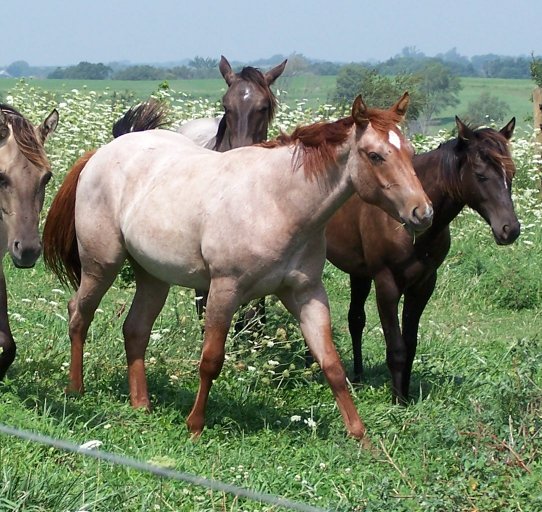 An example (red roan) of complete roaning everywhere except points, mane, and tail |
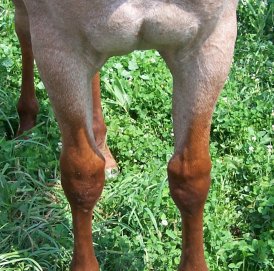 Upside down "V" above knees with dark lower legs, generally found on roans but not sabinos. |
 A very frosty red roan |
 Minimally-roaned true blue roan, showing dark lower legs and the faint upside down "V" where roaning meets non-roaned legs. |
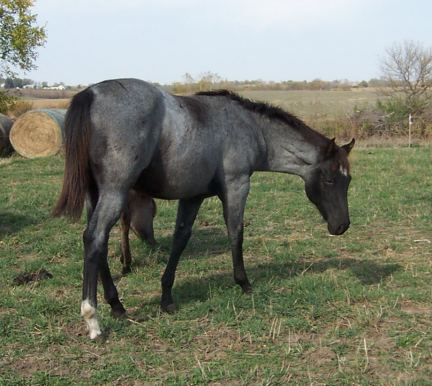
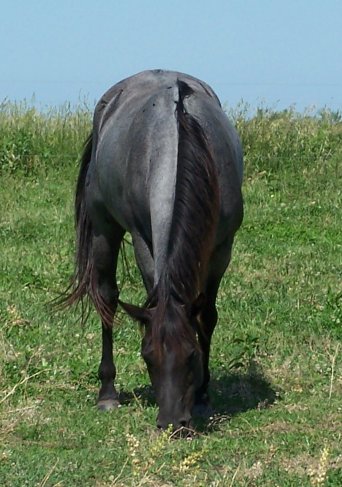 Blue Roan. Note the dark head and lower legs. |
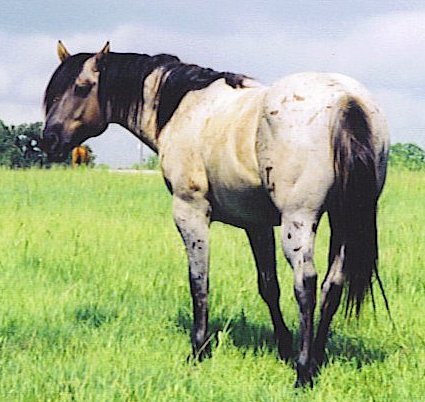 A dun roan showing the "corn" spots where he has been scuffed or injured in years past. |
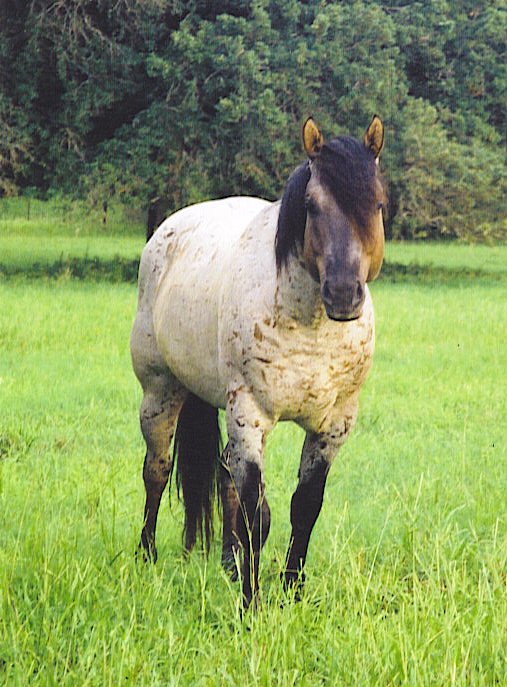 A dun roan showing the upside-down "V" of black above knees and "corn" spots. |
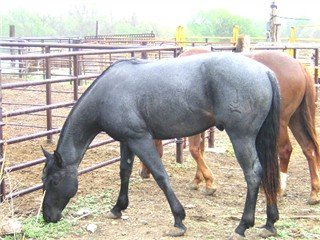 A blue roan, showing the even distribution of white hairs all the way up the neck to the head. |
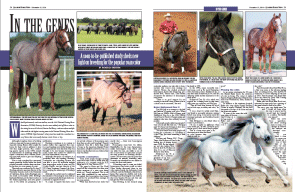
A great article hilighting roan, rabicano, and general white-pattern topics
from Quarter Horse News.
Sabino White Pattern
The University of California (Davis) offers a DNA test for the sabino pattern. Characteristics that Sabino horses "might" have include:
|
|
|
|
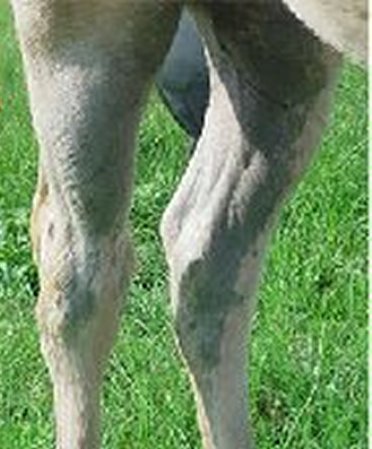 Sabino leg stockings, with the sharp points on the fronts of the legs. |
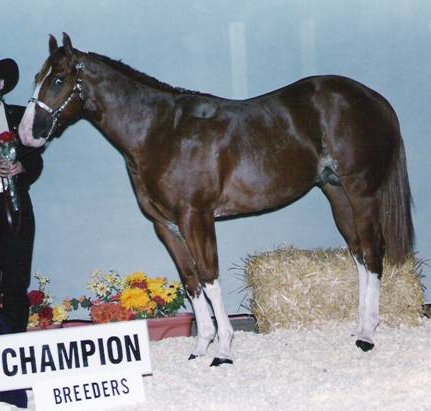 Showing mostly Sabino, (but possible Rabicano pattern also). Note the chin, stockings with points, and ticking between front legs and at flanks. |
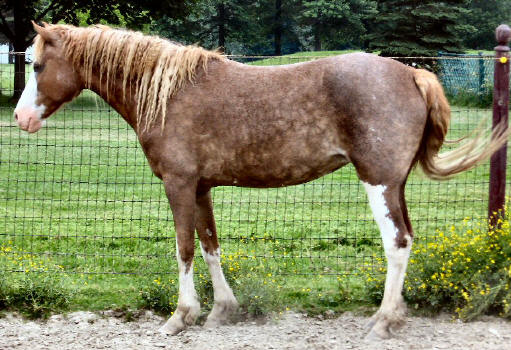 A sabino Curly |
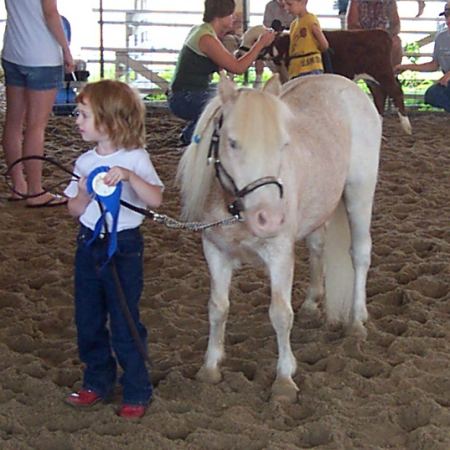
http://www.painthorsejournal.com/archives/pdfs/TheScienceofSabinoAug07.pdf
Excellent reference about Sabinos, with photos and explanations
(let me know if this link goes away)
Rabicano White Pattern
Rabicano is a pattern of white hairs that's similar to roan, but which does not cover as large of an area as the true roan gene causes. It consists of white hairs that center from/concentrate on the flanks of the horse and at the top of the tail, as well as under the belly. The white hairs on the flanks often go as far as onto the rib area, where they may even appear to make a vertical striping pattern. The neck is usually not affected, or not affected to a great degree. The back/topline is also mostly unaffected, though some rabicanos have roan-ing up to the backbone.
Rabicano is caused by a dominant gene, so half of a rabicano's offspring will receive the trait.
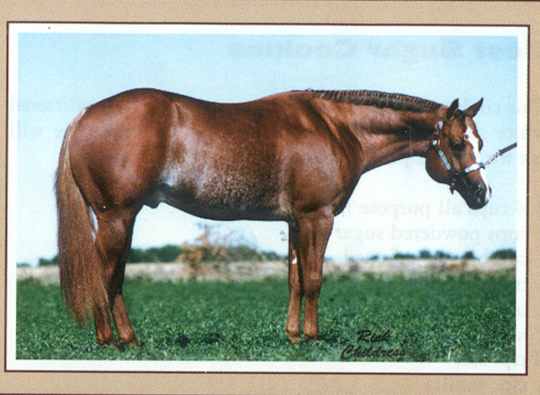 Absolute Investment Click his photo to see the white ticking up close. |
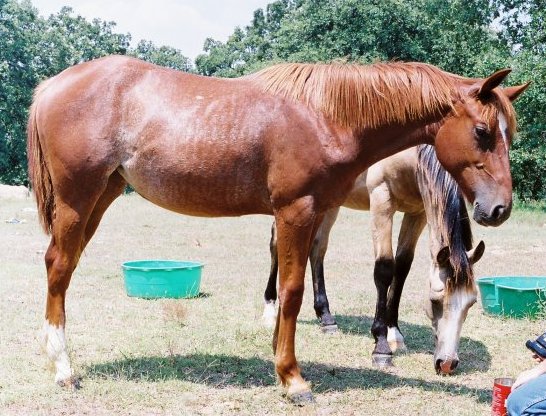 Rabicano pattern on a Quarter Horse |
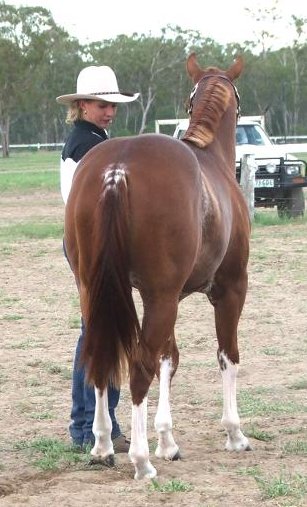 "Coon Tail" |
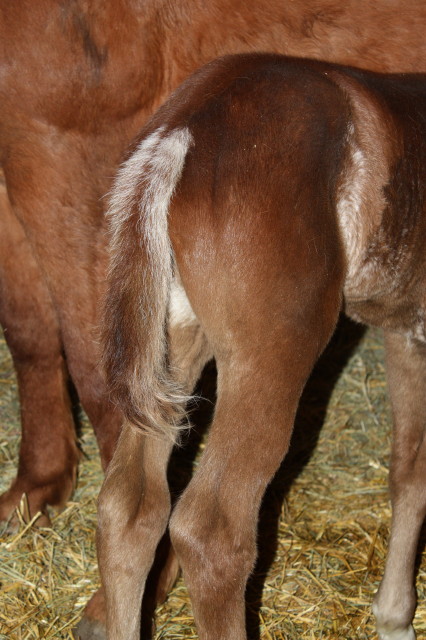 "Coon Tail" and flank roaning from rabicano |
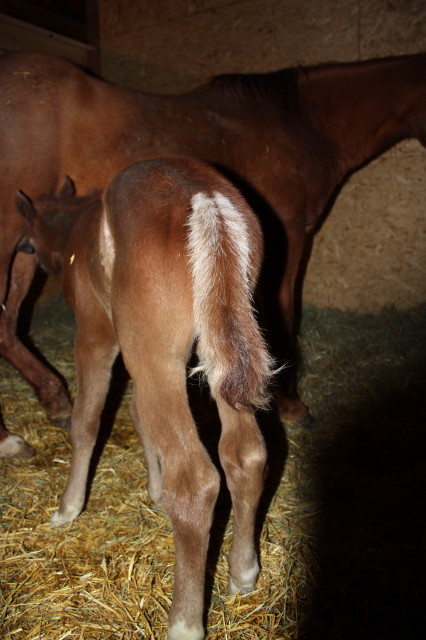 "Coon Tail" from rabicano |
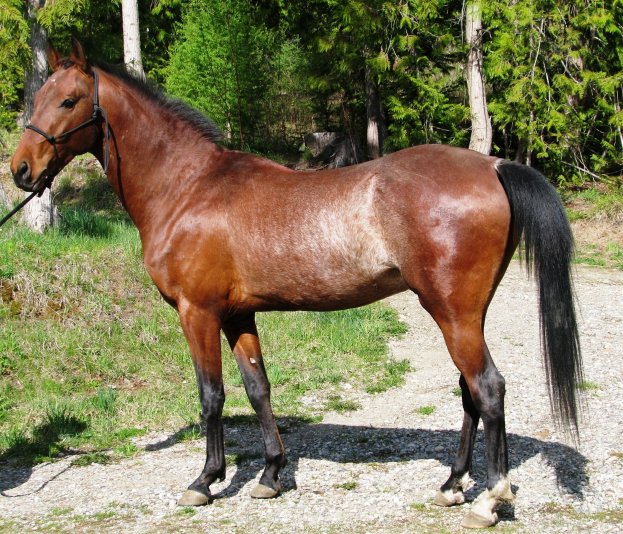 |
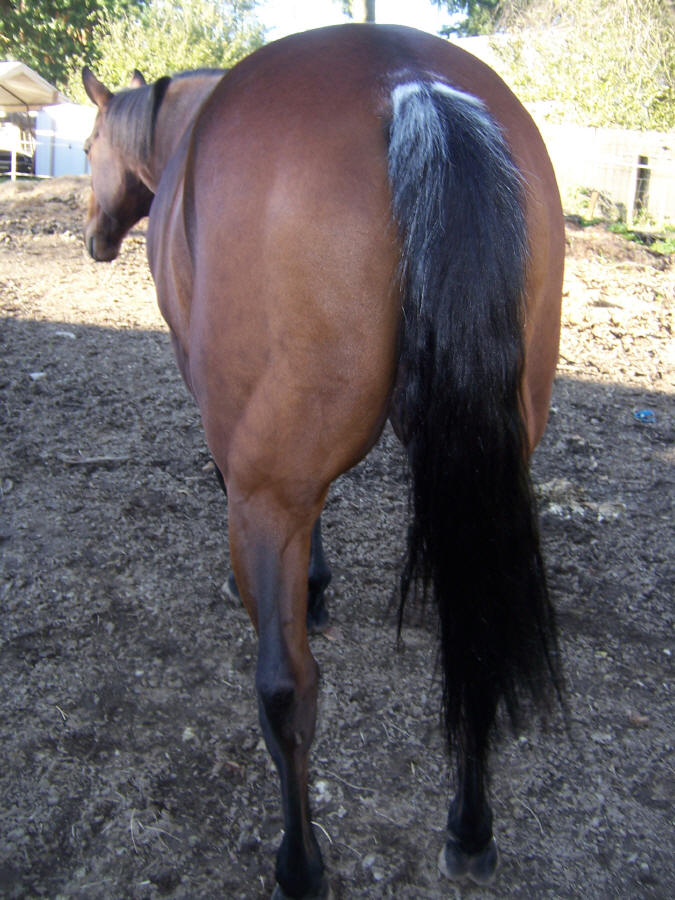 "Coon Tail" from rabicano |
 |
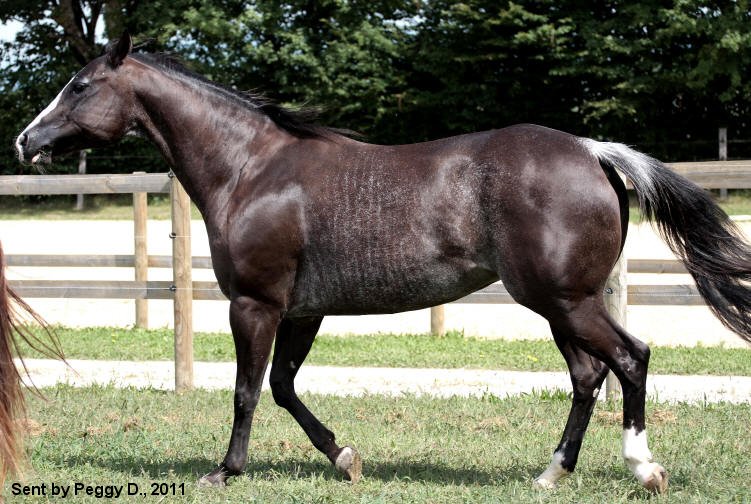 A very dark chestnut rabicano by Sudden Impulse. |
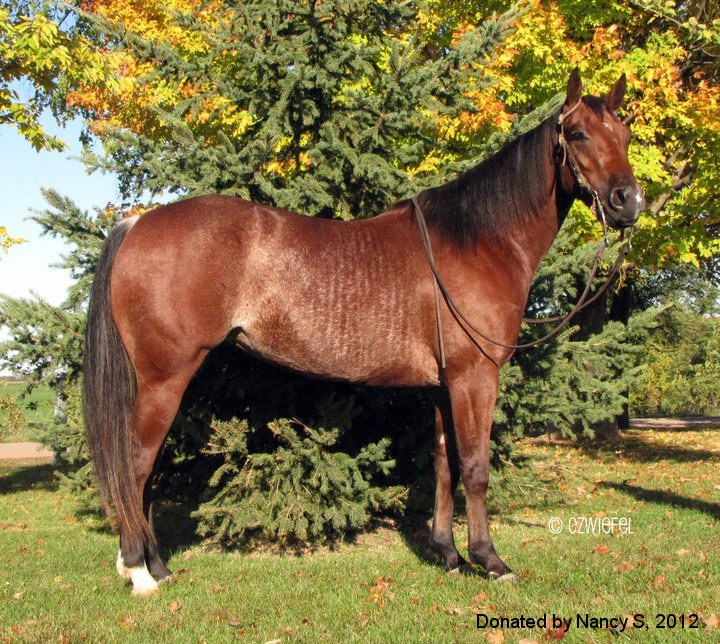 |
If you have a good photo that would help educate viewers, feel free to send it for possible inclusion on our page. |
Combinations of Two or More White Pattern Genes
These colors are not mutually exclusive...they can occur together. Many roans are also rabicano carriers, but the roaning is the predominant color and so the horses are simply recognized as roans. Below are examples of roans that are carrying a roan gene and ALSO a sabino or rabicano gene.
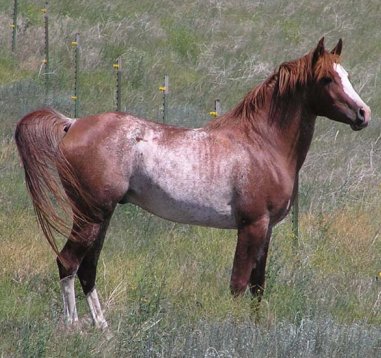 Mainly expressing rabicano, but also possible sabino. However, this horse does NOT carry a roan gene. Gorgeous, huh? :-) |
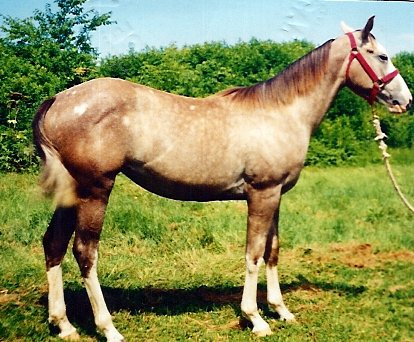 An intermediate-shade of gray in maturity, plus showing a possible sabino gene (see the white on face and high stockings). |
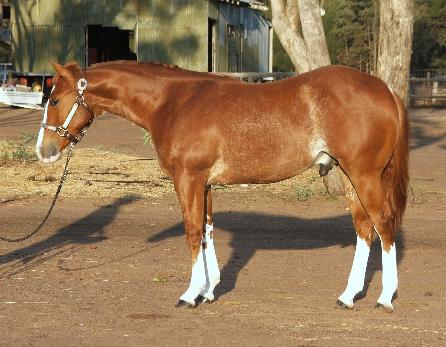
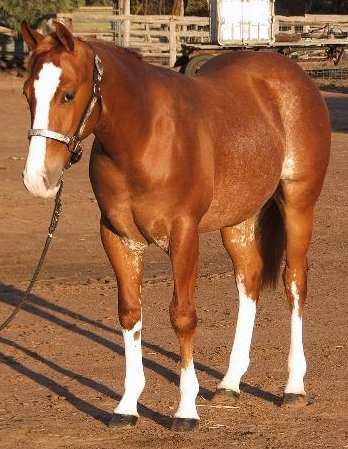 A young horse showing possible rabicano roaning on the flanks/ribcage, and sabino high white socks, chest, and facial markings. |
Gray
Horses carrying one or two copies of the dominant form of the gray gene (G for gray, g for non-gray) may be born any color, but will eventually become white or fleabitten grays. The pattern of white/gray hairs in their coats may be obvious soon after birth, or may even take a few years to become apparent. I have seen a couple gray grand-get of Jackie Bee that didn't have a gray hair on them until they were several years old, and then slowly turned white over years. Most grays turn obviously gray by age 3 to 5, however. Their first couple years might be described as "beautiful" or "ugly," depending upon the eye of the beholder and the base color.
Gray foals are born any color (depending upon the genetics of the sire and dam), changing slowly to a rose gray or dapple gray, and then to a white coat or fleabitten gray coat. Dapple grays and rose grays are both intermediate colors that a horse exhibits during it's life while graying (beginning with the foal coat color and ending up white or flea bitten). When the horse has finished the graying process, it will have a white coat or a fleabitten gray coat (a white coat with tiny speckles of sorrel or black dotted randomly on the body). Dapple gray and rose grays only occur in the steps between "dark" and "white."
In their first couple years, grays are often mistaken for
roans. They shouldn't be, however. Grays have gray hairs on
their faces and heads very early on, and are usually lighter colored on
their heads than bodies. This is the opposite of roans, who have
darker heads than bodies.
|
|
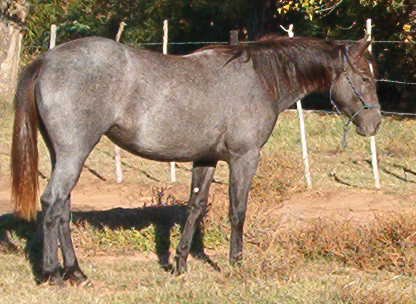
 Young gray horses that will turn white/a variation of gray or fleabitten. |
 Intermediate gray (will turn white or flea bitten). Note the graying tail and light face/eye area. |
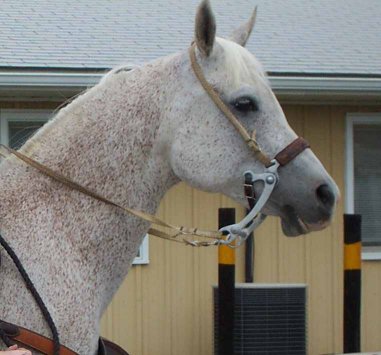 Flea-bitten gray. Click photo to see the "flea bites" on this gray horse. |
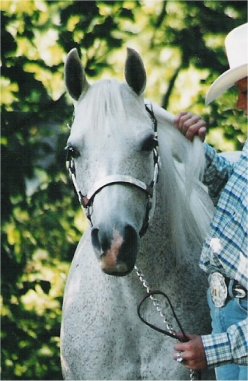
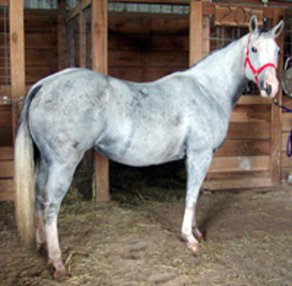 Mature gray coat color. Note the white/light face, dark skin, and dark eye color. |
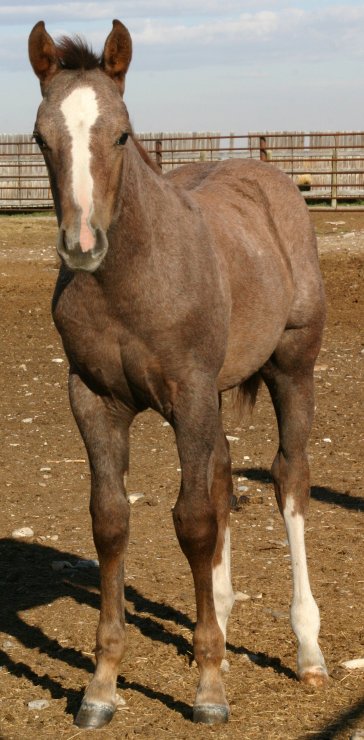
 A gray weanling. Note the even distribution of gray hairs on the face, which is a characteristic of grays. |
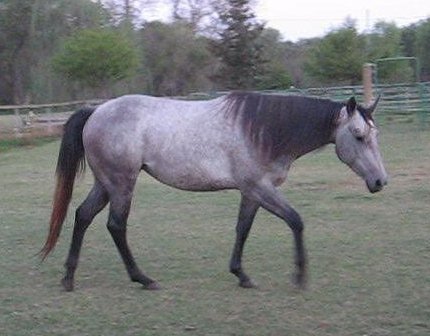 A young gray. Note the light head and the graying at the bottom of the tail. |
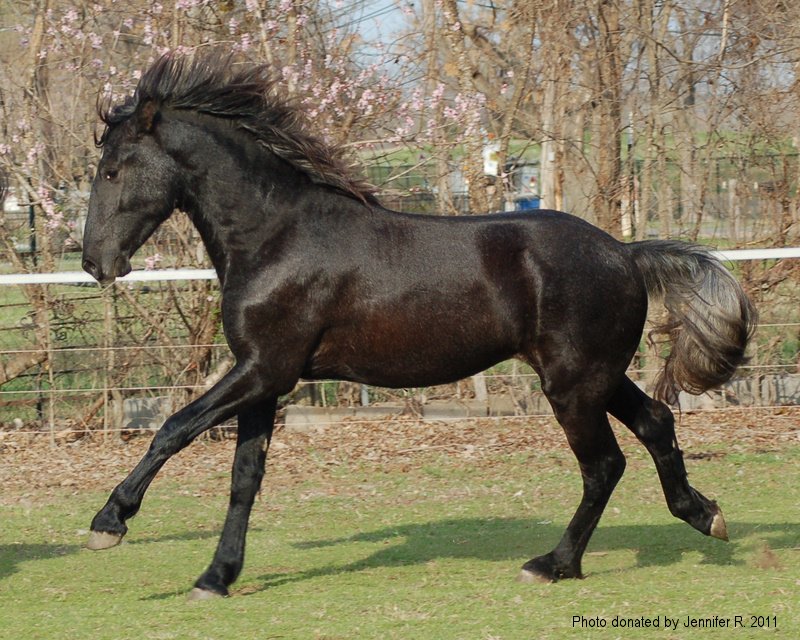 This Warlander 2 year old is slow to turn gray, but his tail is showing a telltale sign. |
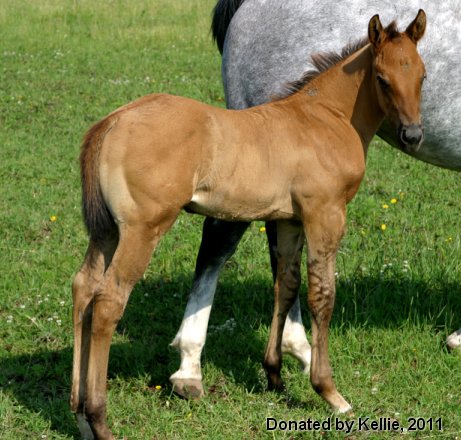
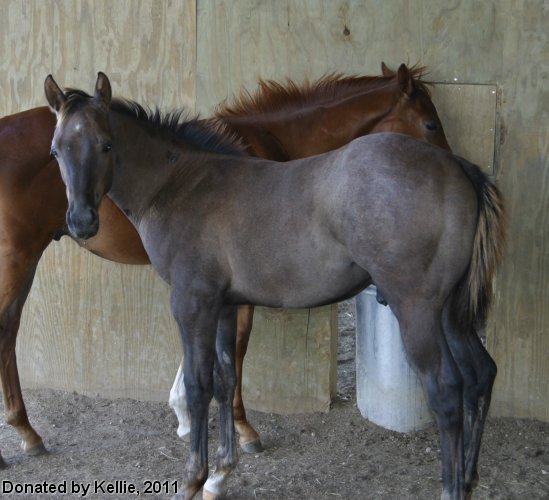
 This foal looked red dun at birth, but had a telltale sign of inheritance of the gray gene by the rich-colored leg hair (as opposed to the dull, buff-colored leg hair that a red dun would usually have). He shed off charcoal color, and could have tricked some into thinking he was grullo. But the mature photo shows that the gray progressed on schedule. |
|||
|
If you have a good photo that would help educate viewers, feel free to send it for possible inclusion on our page. |
|||
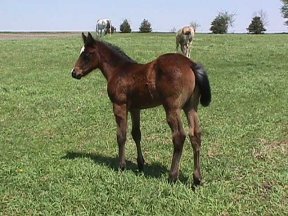
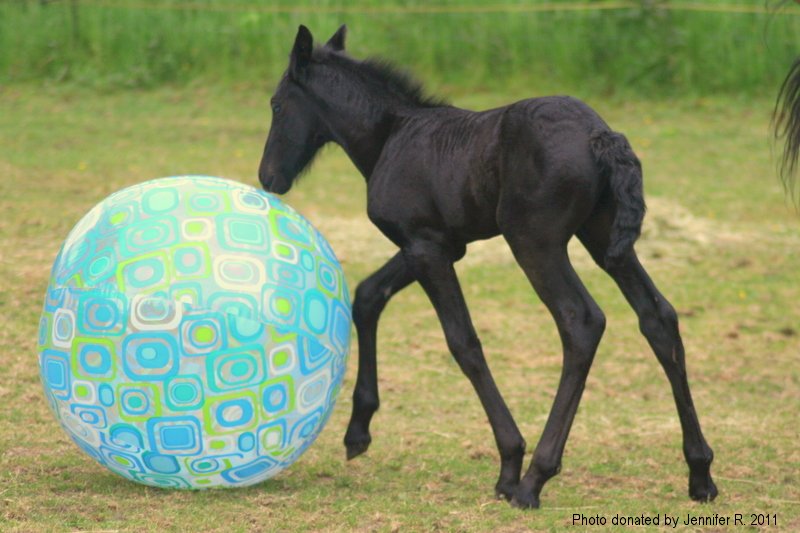
For more information, visit www.grullablue.com/colors/gray_roan.htm
Appaloosa Roaning
"These horses closely resemble roans and greys. The color develops similarly to grey, in that it gradually overtakes the previous color pattern and covers it up. It is called "varnish" because its action is much like that of brushing varnish over a still-wet painting. The colors will blur and blend into a new, mottled and non-distinct pattern of coloring. Varnish Roan is part of the appaloosa complex. " (Source: http://www.mustangs4us.com/Horse%20Colors/roan-ish_variations.htm)
It differs from the usual pattern of roan in that the head has white hairs and the colored hairs are concentrated over the bony prominences (facial bones, withers, shoulders, knees, stifles, and pelvic bones). These darker areas are called "Varnish Marks". This pattern will likely change with the age of the horse, since many are born solid and develop this pattern later in life. (Source: http://www.equiworld.net/uk/horsecare/colours/ )
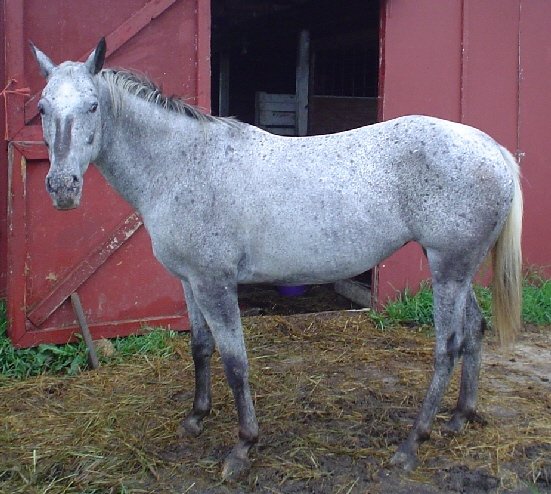 A gorgeous varnished Appaloosa (note the dark bridge on the nose and lower legs). |
 Varnished POA mare. Note face varnishing. |
If you have a good photo that would help educate viewers, feel free to send it for possible inclusion on our page. |
If you have a good photo that would help educate viewers, feel free to send it for possible inclusion on our page. |
References and Informative Links
A great article hilighting roan, rabicano, and general white-pattern topics.
http://www.painthorsejournal.com/archives/pdfs/SabinoDec98.pdf
-
http://greenfield.fortunecity.com/dreams/799/hc/rabicano.htm
-
http://www.mustangs4us.com/Horse%20Colors/roan-ish_variations.htm
-
http://colormorgans.tripod.com/othercolors.htm Excellent photos of rabicano characteristics
Photo Ownership Notice:
All of the photos on this page are the property of Cedar Ridge QH's or were
sent to us with permission.
If someone has sent a photo to us for use on our pages that belongs to you,
and if they did not have
permission to do so,
please let us know.
If you are interested in contributing a photo, we thank you! But please do not
alter the photo or place your contact
information on it. Our educational pages are for just that...education. Not
advertisements. Thanks!
|
How To Donate Your Educational Photo:
-
If you are wondering what color your foal is, click here. We are having a lot of people send us pictures for this page where it is obvious that the foal owners don't know what color their foal is. Please, only send us photos for this page if you know your foal's color. If you don't know what color your foal is, click here.
-
If you foal is a Paint or Appaloosa, we will only use it if the vast majority of the foal's body is not included in the white patterned areas (unless it is for a section of the page/site for Appaloosa markings), as this page is intended to help people determine colors, so the colored hairs must be very obvious.
-
This is an educational page, and photos should show a safe environment and healthy horses. I don't even know how to respond when I receive photos of wormy, skinny horses in pastures littered with abandoned cars, farm equipment, wire fences laying on the ground, and falling-down buildings. I simply can't put photos like that on an educational page like this, where people come to learn.
-
Please note that this is not intended to be a free opportunity for you to advertise your breeding operation, and instead is an educational page. We will not use photos with watermarks/writing on them. There are many free advertising sites on the Internet at which you can advertise your farm/ranch/horses. Also, only send photos of foals you own. This way, there won't be copyright problems.

Feel free to click the "Send Your Photo" logo
at the left to send a good photo or two to us for inclusion on our
color pages.
This page last updated
05/28/21
If you notice this date being 2 years or older, please let
us know that we need to check out this page!
Home Horses For Sale Stallions Mares Foals Blog Color Genetics Riding Horses Site Map Contact Us

Toni Perdew
Bedford, Iowa
toni@grullablue.com
712-370-0851 cell, before 9 p.m. CST

www.facebook.com/CedarRidgeQuarterHorses
Web design by
CR
Equine Sites.
All rights reserved. Graphics are watermarked for copyright protection.
Terms of Use