









Roan VS Gray
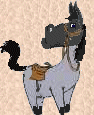
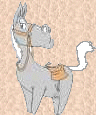
Roan (left), Gray (right)
|
I've seen or heard it so many times...a young gray horse being called a roan. An experienced horse person who has been active in training many competitive young 4-H and FFA horse contest teams even told me once, "You call it by the color it is on THAT day of the contest. Maybe it will be gray some day, but if it is a mixture of colored and white hairs on contest day, it's a roan."
No wonder those kids didn't win the contest.
If you want to call a horse a roan, make sure the horse has a dark head that isn't turning gray. If you want to call a horse a gray, make sure it isn't a roan to be most correct. Both grays and roans can have a mixture of light and dark hairs in their bodies, but they have some VERY different characteristics that set them apart as totally different colors. Gray and roan colors are caused by two totally different genes. This article will hopefully help you easily determine the difference between the two genes.
Gray
Horses carrying one or two copies of the dominant form of the gray gene (G for gray, g for non-gray) may be born any color, but will eventually become white or fleabitten grays. The pattern of white/gray hairs in their coats may be obvious soon after birth, or may even take a few years to become apparent. I have seen a couple gray grand-get of Jackie Bee that didn't have a gray hair on them until they were several years old, and then slowly turned white over years. Most grays turn obviously gray by age 3 to 5, however. Their first couple years might be described as "beautiful" or "ugly," depending upon the eye of the beholder and the base color.
|
AREA OF NOTE |
DESCRIPTION |
| SKIN | Black/dark skin.* |
| EYES | Normal eye color (usually brown, unless another color gene causes them to be hazel/light). |
| FOAL COAT | Can be born any color...they are NOT always born black! |
| LEGS | Often, the legs on a gray foal are brilliantly colored at birth instead of "buff." For example, a bay foal that will become a gray will often have shiny black legs right from the beginning. A bay foal that is not going to become gray will generally have tan legs at birth that later shed off black. |
| FACE, MANE, TAIL | These will gray out early and will eventually become white for the most part. If the face, mane, and tail remain dark colored, the horse is probably a roan. |
| FIRST TO GRAY OUT | The first part of a foal to begin to gray is "usually"
the head. Look for white hairs on young horses
On a horse that is a couple years old or older, look at the bottom of the tail also. It will usually begin to lose color from the bottom up. |
| PARENTAGE | Since gray is produced by a dominant gene, at least one parent of a gray horse must be gray. If a gray horse does not have a gray parent, then it should be seriously considered that the expected parentage is incorrect. |
For the most part, this description might help:
Gray foals are born any color (depending upon the genetics of the sire and dam), changing slowly to a rose gray or dapple gray, and then to a white coat or fleabitten gray coat. Dapple grays and rose grays are both intermediate colors that a horse exhibits during it's life while graying (beginning with the foal coat color and ending up white or flea bitten). When the horse has finished the graying process, it will have a white coat or a fleabitten gray coat (a white coat with tiny speckles of sorrel or black dotted randomly on the body). Dapple gray and rose grays only occur in the steps between "dark" and "white."
WARNING!
If you want a dapple gray horse, and you buy one,
don't expect it to stay that way its whole life.
It will most likely end up white or fleabitten gray.
Photos
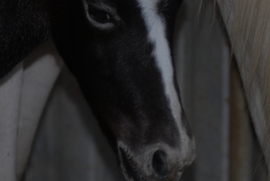
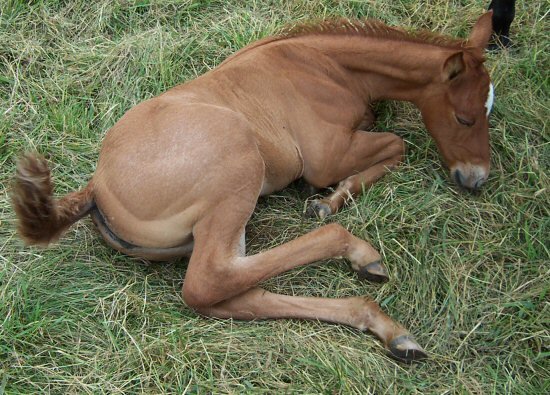
| A gray newborn foal. The gray around the eyes indicate that this foal will most likely turn gray. |
 |
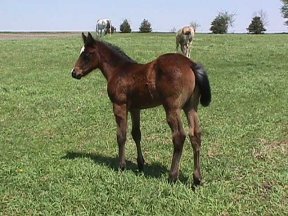
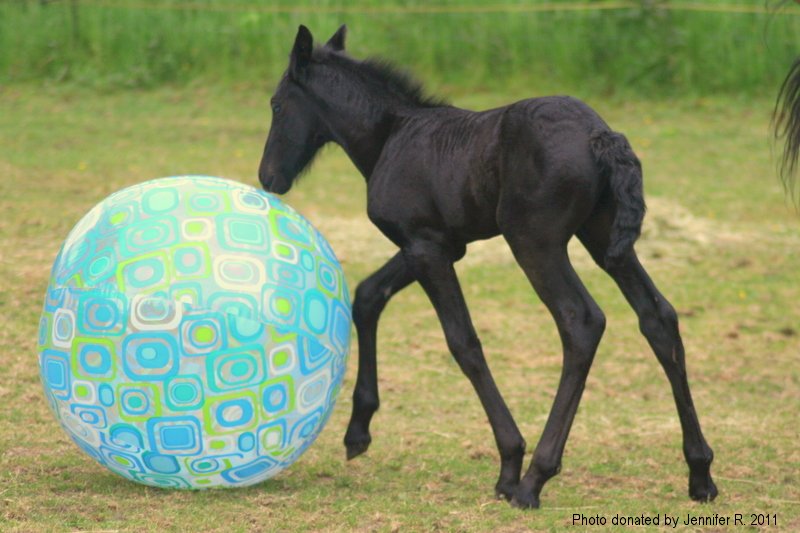
| Young gray foals that aren't yet showing that they have a gray gene. They eventually turned gray. |
 |
| A young gray Warlander showing the progression of gray on his face. |
 |
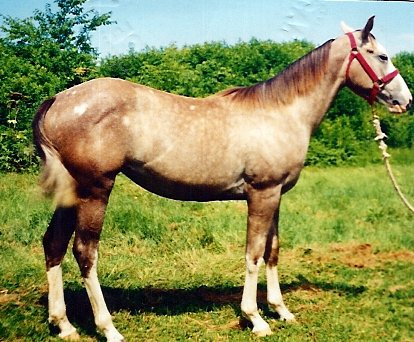
| Intermediate gray (will turn white or flea bitten). Note the graying tail and light face/eye area. |

 |
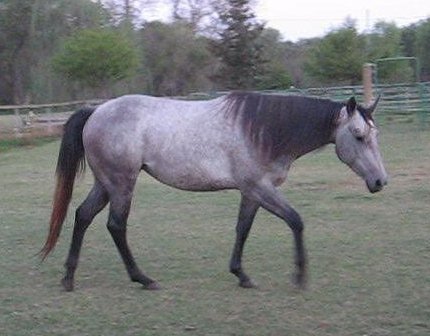
| A young gray. Note the light head and the graying at the bottom of the tail. |
 |
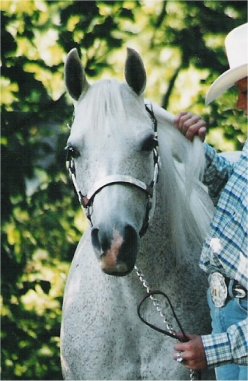
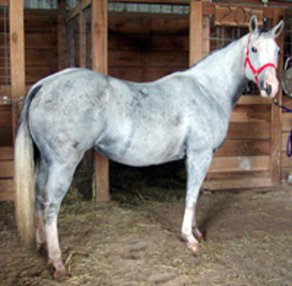
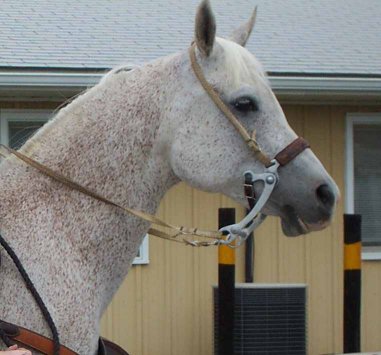
| Mature gray coat color. Note the white/light face, dark skin, and dark eye color. |
 |
| Flea-bitten gray. Click photo to see the "flea bites" on this gray horse. |
 |
Mistaking Grays and Roans
In their first couple years, grays are often mistaken for roans. They shouldn't be, however. Grays have gray hairs on their faces and heads very early on, and are usually lighter colored on their heads than bodies. This is the opposite of roans, who have darker heads than bodies.
Roan
Information coming soon...
|
AREA OF NOTE |
DESCRIPTION |
| SKIN | Black/dark skin.* |
| EYES | Normal eye color (usually brown, unless another color gene causes them to be hazel/light). |
| FOAL COAT | Can be born any color, and generally sheds off roan by weaning time. |
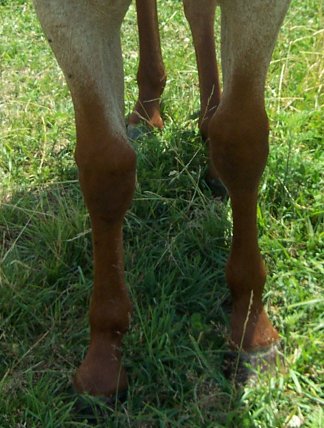
| LEGS, FACE, MANE, TAIL | These remain solid colored! Front legs usually have an upside down "V" that points upward that divides the dark legs from the roan upper leg/body. |
| LOCATION OF ROAN HAIRS |
|
| PARENTAGE | Since roan is produced by a dominant gene, at least one parent of a roan horse must be roan. If a roan horse does not have a roan parent, then it should be seriously considered that the expected parentage is incorrect (unless another color gene covers the color). |
Photos
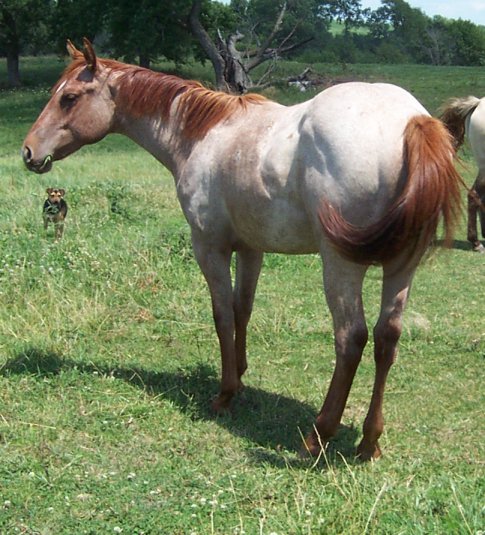
Note the dark face, mane, tail, and legs of the roans after shedding foal coats.
| Color at Birth/Foal Coat | After Shedding or Maturing |
|
|
|
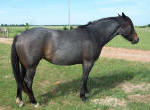
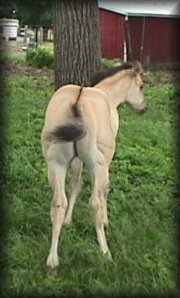 Born grullo... |
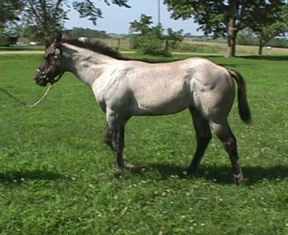 Shed off grullo roan (blue roan variation) |
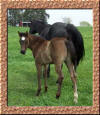
 Born bay |
 Shed off bay-based roan |
 Born black |
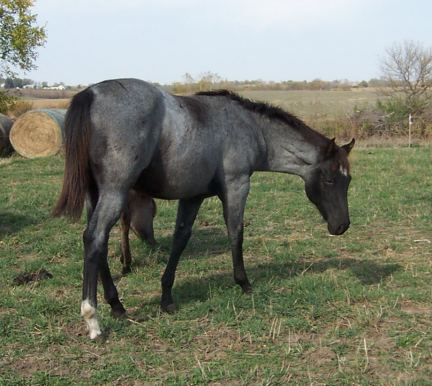 Shed off blue roan (black head) |
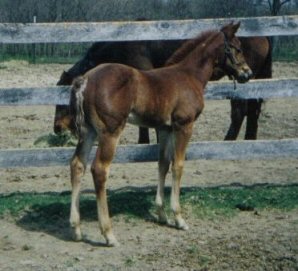 Born chestnut |
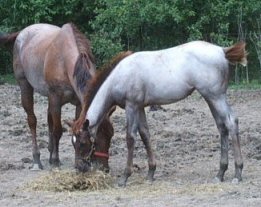 Shed off liver-based roan (red roan), which is genetically the same as strawberry/red roan. |
| Roan "upside down V" on front legs that divides the dark lower leg from the roaned upper leg and body |
 |
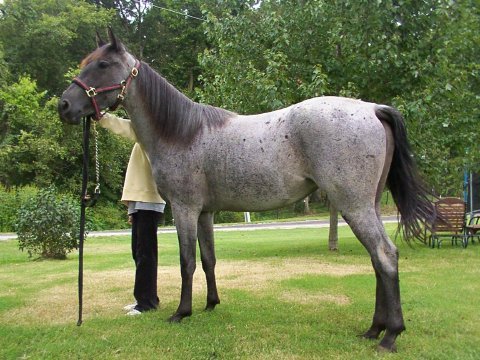 Blue roan Tennessee Walking Mare |
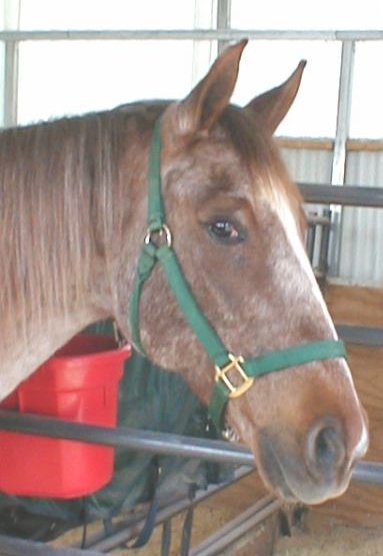 An extremely roaned head. Notice that the face is roaned, but the eye area is NOT. |
Mistaking Grays and Roans
In their first couple years, grays are often mistaken for roans. They shouldn't be, however. Grays have gray hairs on their faces and heads very early on, and are usually lighter colored on their heads than bodies. This is the opposite of roans, who have darker heads than bodies.
Gray AND Roan Both...Yes, it can happen!
The horse that inherits both a roan and a gray gene from
its parents
may look roan for its first few years,
but it will look gray for the rest of its life.
Crossing a mare and stallion who carry gray and roan genes is just fine, but can cause a lot of confusion. Foals may be born looking like they'll be roan, but after a couple years, they may turn gray. Some breeders believe that the gray and roan genes compliment each other, making for a more roaned roan. But in actuality, the gray gene will completely mask the roan gene within a few years, leaving only a gray-looking horse.
This is great for those who love grays.
But...
If a breeder crosses horses that could result in a
roan foal that could carry a gray gene as well, we sure hope they will
inform the buyer of the foal to avoid potential hard feelings. If the
buyer likes and expects a gray, they will be pleased. However...If
they wanted (and specifically bought and paid the price for) a roan and end up with a gray, they could have very bad feelings
about the seller!
| Born bay, but carries both a gray gene and a roan gene. Will turn totally gray at maturity of color, and will NOT show roaning due to the graying. |
|
|
Roan+Gray+Probable Dun genes Note the upside-down "V" above the knees, which is a good indication of roaning. This horse throws roans and grays from sorrel and bay mares. |
|
|
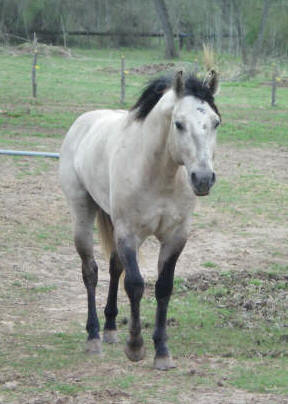
Gray+Dun with possible Roan and Cream genes |
 |
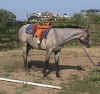
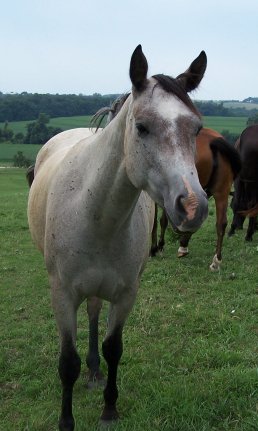
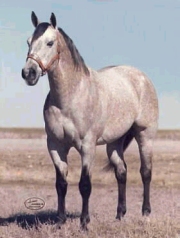
Compare Gray and Roan Side By Side
| GRAY Light face, light tail, light lower legs |
ROAN Dark face, dark mane and tail, dark lower legs |
|
Light tail |
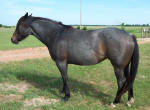 Dark Tail |
| Light head |
Dark head |
|
|
|
|
At maturity, light legs |
At maturity, dark legs |
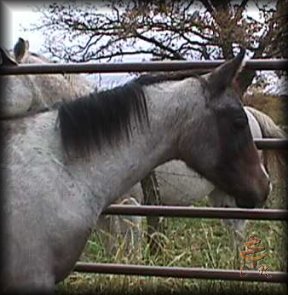
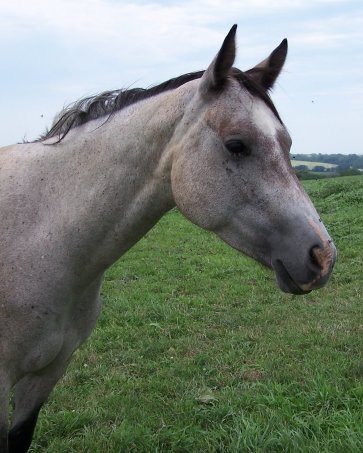 Gray heads. Notice the white/gray hairs all the way to the eyes. |
An extremely roaned head. Notice that the face is roaned, but the eye area is NOT. |
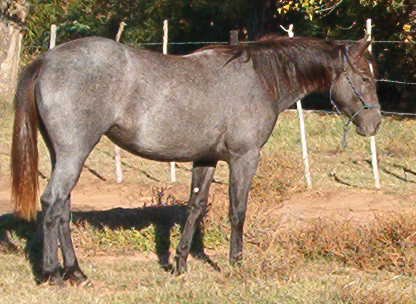 A young gray horse that will turn white-gray/fleabitten. |
|
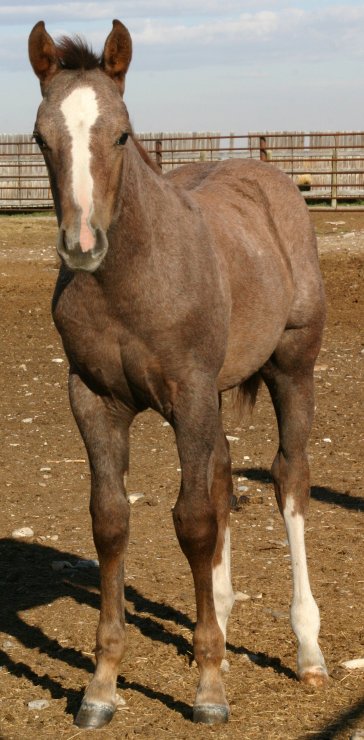
 A gray weanling. Note the even distribution of gray hairs on the face, which is typical of grays. |
|
| GRAY Light face, light tail, light lower legs |
ROAN Dark face, dark mane and tail, dark lower legs |
*If the skin is pinkish, the horse is probably a cremello or perlino (having two dominant forms of the creme gene). It can also carry a gray gene if a parent was gray, but you might not be able to tell easily due to the double dilution.
Request help determining your horse or foal's color
References
- http://www.unicornerfarm.com/greyhoss.htm
- http://www.nationmaster.com/encyclopedia/Gray-(horse)
- http://www.vgl.ucdavis.edu/~lvmillon/coatcolor/coatclr3.html#fig1a
How To Donate Your Educational Photo:
-
If you are wondering what color your foal is, click here. We are having a lot of people send us pictures for this page where it is obvious that the foal owners don't know what color their foal is. Please, only send us photos for this page if you know your foal's color. If you don't know what color your foal is, click here.
-
If you foal is a Paint or Appaloosa, we will only use it if the vast majority of the foal's body is not included in the white patterned areas, as this page is intended to help people determine foal colors, so the colored hairs must be very obvious.
-
This is an educational page, and photos should show a safe environment and healthy horses. I don't even know how to respond when I receive photos of wormy, skinny horses in pastures littered with abandoned cars, farm equipment, wire fences laying on the ground, and falling-down buildings. I simply can't put photos like that on an educational page like this, where people come to learn.
-
Please note that this is not intended to be a free opportunity for you to advertise your breeding operation, and instead is an educational page. We will not use photos with watermarks/writing on them. There are many free advertising sites on the Internet at which you can advertise your farm/ranch/horses. Also, only send photos of foals you own. This way, there won't be copyright problems.

Feel free to click the "Send Your Photo" logo
at the left to send a good photo or two to us for inclusion on our
color pages.
Photo Ownership Notice:
All of the photos on this page are the property of Cedar Ridge QH's or were
sent to us with permission.
If someone has sent a photo to us for use on our pages that belongs to you,
and if they did not have
permission to do so,
please let us know.
If you are interested in contributing a photo, we thank you! But please do not
alter the photo or place your contact
information on it. Our educational pages are for just that...education. Not
advertisements. Thanks!
|
This page last updated
05/28/21
If you notice this date being 2 years or older, please let
us know that we need to check out this page!
Home Horses For Sale Stallions Mares Foals Blog Color Genetics Riding Horses Site Map Contact Us

Toni Perdew
Bedford, Iowa
toni@grullablue.com
712-370-0851 cell, before 9 p.m. CST

www.facebook.com/CedarRidgeQuarterHorses
Web design by
CR
Equine Sites.
All rights reserved. Graphics are watermarked for copyright protection.
Terms of Use