

Cedar Ridge Foals
Nutrition Training Health Registration Paying
2021 Foals 2020 Foals 2019 Foals 2018 Foals 2017 Foals 2016 Foals 2015 Foals 2014 Foals 2013 Foals 2012 Foals 2011 Foals 2010 Foals 2009 Foals 2008 Foals 2007 Foals 2006 Foals 2005 Foals 2004 Foals 2003 Foals 2002 Foals General Foal Information
Feeding/Nutrition
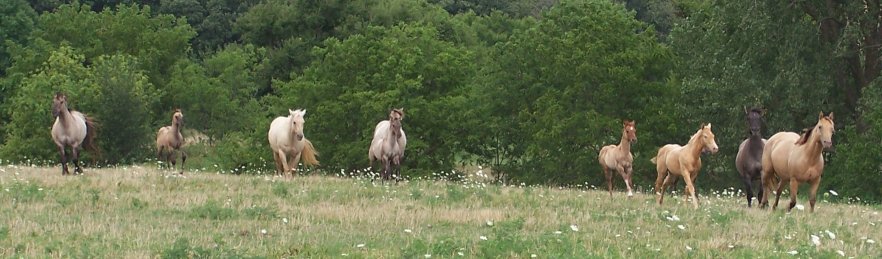
We raise our foals in a natural atmosphere, on green pasture and natural mare's milk (with few exceptions where a mare may need dry lotted). Our mares stay in good condition on our rich Iowa grass, so we don't feed them much (if any) grain during the summer and fall. Our foals are not pushed for early growth with excessive grains....They eat only what it takes to get them interested in grain so they wean better. This helps avoid epiphysitis, contracted tendons, and OCD/DOD, which can be permanently damaging.
So when we sell them, they are just healthy, sound, average-sized foals, and are not too large or overweight (which would be unhealthy for their bones and joints). We do this because we think it's right, and because the majority of our market wants it this way.
However, once you buy a foal, you can customize its feeding program to meet your own needs...we just get them ready for you to do that.
Why, when bigger foals bring more money?
We want our foals to have the best possible opportunity to live long, sound lives. We do not push our foals to be overly large because we feel it is not in the best interest of our foals' legs and hooves at the ages we own them, nor the future owners of our foals. A diet high in grain rations can cause several disorders of the joints in young foals and can lead to permanent damage. Perhaps this is why we have also found that a lot of potential buyers will not buy foals that have been pushed. For these reasons, our foals are not generally shown before we sell them. They simply don't compete in a halter class (in the short run, while we own them) with a big foal that has been pushed with large amounts of concentrates, additives, and/or hormones.
Our foals still achieve about the same size and look as they would with more grain, but their growth lasts a little longer. If you continue with a natural-growth program (not pushing too much concentrate), your foal will just be a few months behind its counterparts who have been pushed harder, but your foal will mature just as nicely....and hopefully with sounder joints and hooves. You can feed more concentrates once you take the foal home. That's up to you to decide. New owners can better manage that type of feeding program than we can, so we leave that up to you.
We just give them the good start it takes to succeed in any feeding program later.
We hope you're glad that we care about our foals, and that we do this for their benefit...and YOURS!
Nutrition Training Health Registration Paying Back to Top
Socialization with People
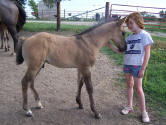
Most of our foals are handled immediately and are fairly-well imprint trained at birth. For their first week of life, they are handled frequently, dewormed, and watched closely for health. After that, they are allowed to return to pasture with their dam where they are frequently exposed to humans, but are not haltered and led daily. Most of our foals willingly come up to us for attention (rubs, scratches) during this time. A few are more shy, and gain confidence later than others.
Sometimes we halter train them prior to weaning, but we have recently begun halter breaking foals after weaning and really like it. We can take time and be very gentle with them, and it's working well for us.
So far, we've never sold a foal that wasn't halter broke or that didn't load in a trailer. That is part of the training we give them while they are here. If we do have a foal that needs to leave quickly at its new owner's request, we may offer a discount if he/she has missed any of this training.
Keep in mind that ALL foals can be unpredictable because they are young, and that they may behave wonderfully here but may try you at your home until they realize that you are their new handler. If we feel a foal is not behaving well here, we will tell you about it. We will not let you be surprised if we know of an issue.
Nutrition Training Health Registration Paying Back to Top
Health Schedules
Our foals are dewormed at birth, and then are dewormed multiple times with an Ivermectin, fenbendazole, and/or pyrantel pamoate dewormer over the next 5 months.
We used to give vaccinations just prior to weaning, but have switched to vaccinating right after weaning for most foals. We will continue to discuss this with vets, and will try to change this page when we change our practice.
Nutrition Training Health Registration Paying Back to Top
Registration
We will hold off on registering a foal until is approaches 12 months of age so that its new owners can choose the foal's registration name. We have found that most people want to name their foals, rather than accepting some clunky name we think of (I'm horrible at naming). But when a foal approaches 12 months and if we still own it, we will register it and name it as we wish. Buyers can still rename the foal if they desire by paying AQHA for the renaming fee.
If you buy a foal that has not yet been registered, you will receive its registration application and a transfer paper. It will be up to you to name and register the foal before it is 7 or 12 months old to avoid extra fees for the later registration.
If you buy a foal that has already been registered, you will receive its papers and a transfer report. You can leave its name as is, or you can communicate with AQHA about changing the name if you desire.
Nutrition Training Health Registration Paying Back to Top
Click the links at the top of this page to see our individual foals' pages by year of birth.
This page last updated
01/21/21
If you notice this date being 2 years or older, please let
us know that we need to check out this page!
Home Horses For Sale Stallions Mares Foals Blog Color Genetics Riding Horses Site Map Contact Us

Toni Perdew
Bedford, Iowa
toni@grullablue.com
712-370-0851 cell, before 9 p.m. CST

www.facebook.com/CedarRidgeQuarterHorses
Web design by
CR
Equine Sites.
All rights reserved. Graphics are watermarked for copyright protection.
Terms of Use